


How Artificial Intelligence Is Changing Our Daily Lives
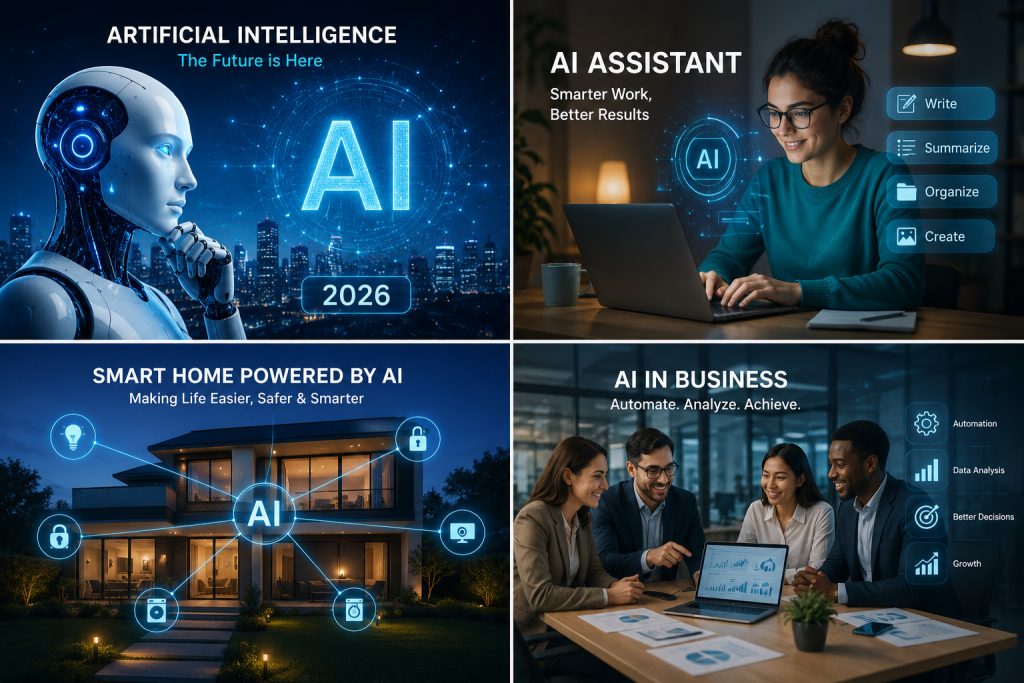
Artificial Intelligence (AI) is no longer a futuristic idea—it’s now part of our everyday lives. In 2026, AI is helping people work faster, learn smarter, create content, improve healthcare, and automate businesses. Companies around the world are investing heavily in AI technologies, making it one of the biggest technology trends of the year.
1.AI in Education
Students can now use AI to summarize notes, solve problems, learn languages, and receive personalized tutoring. Teachers are also using AI to prepare lessons and grade assignments more efficiently.
2. AI in Business
Businesses are automating customer support, marketing, content writing, and data analysis. Small businesses can now compete with larger companies by using affordable AI tools.
3. AI in Healthcare
Doctors are using AI to detect diseases earlier, analyze medical reports, and improve patient care. AI is helping hospitals save time while improving diagnosis accuracy.
4. AI for Content Creators
Bloggers, YouTubers, and social media creators use AI to generate articles, images, videos, voiceovers, and thumbnails in minutes instead of hours.
5. AI and the Future of Jobs
AI is changing the job market rather than simply replacing workers. Skills like AI prompting, automation, data analysis, and digital marketing are becoming increasingly valuable. Experts expect AI-powered tools to remain a major business and technology trend.
Benefits of AI
Saves time and increases productivity.
Reduces repetitive work.
Improves decision-making with data.
Creates new career opportunities.
Makes learning and communication easier.
Challenges
AI also raises concerns about privacy, misinformation, and responsible use. Governments and technology companies continue working on policies to make AI safer and more transparent.
Disadvantages of Artificial Intelligence
While Artificial Intelligence offers many benefits, it also comes with several challenges that users and businesses should be aware of.
1. Job Displacement
AI can automate repetitive tasks, reducing the need for human workers in certain industries. This may lead to job losses unless workers develop new skills.
2. Incorrect Information
AI can sometimes generate inaccurate or misleading information. Users should always verify important facts from trusted sources.
3. Privacy Concerns
Many AI tools process user data to provide better results. Sharing sensitive personal or financial information with AI systems should be avoided.
4. Overdependence on AI
Relying too much on AI can reduce critical thinking, creativity, and problem-solving skills. It should be used as a tool, not a replacement for human judgment.
5. Security Risks
Cybercriminals can misuse AI to create phishing emails, fake websites, malware, and other online scams.
6. Deepfakes and Misinformation
AI can generate realistic fake images, videos, and voices, making it easier to spread false information or commit fraud.
7. Bias and Unfair Decisions
If AI is trained on biased data, it may produce unfair or discriminatory results in hiring, lending, or other important decisions.
8. High Development Costs
Building and maintaining advanced AI systems requires significant investment in computing power, infrastructure, and skilled professionals.
ConclusionArtificial Intelligence is transforming the world by improving productivity, innovation, and efficiency. However, like any powerful technology, it has both advantages and disadvantages. The key is to use AI responsibly, verify important information, protect personal privacy, and continue developing human skills alongside AI.
SEO Title:
How Artificial Intelligence Is Transforming Everyday Life in 2026
Meta Description:
Discover how Artificial Intelligence is changing education, business, healthcare, and content creation in 2026, along with its benefits and future impact.