


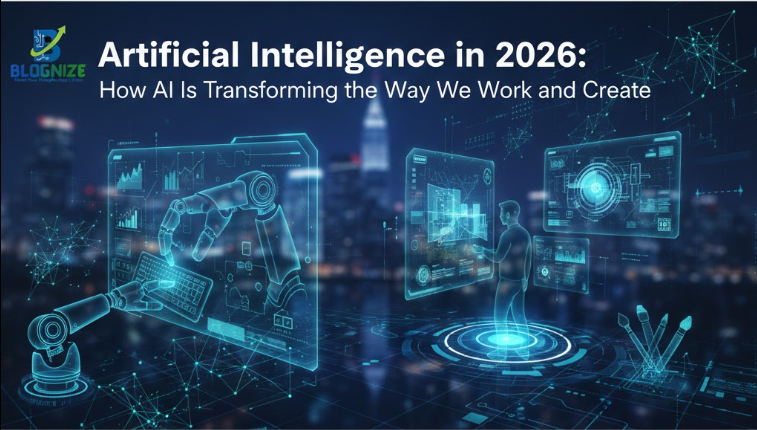
Artificial Intelligence is no longer a futuristic concept.
It’s not something we only see in movies or tech conferences. AI is now part of our daily lives — from the way we search online to the way businesses operate behind the scenes.
In 2026, Artificial Intelligence is not just evolving — it’s reshaping industries, redefining productivity, and changing how we create and communicate.
But what does this really mean for us?
Let’s break it down.
AI Is Changing the Way We Work
One of the biggest transformations AI has brought is in the workplace.
Today, AI tools can:
- Automate repetitive tasks
- Analyze massive datasets in seconds
- Generate reports and summaries
- Improve customer service with smart chat systems
- Assist in decision-making using predictive insights
Businesses are using AI to increase efficiency and reduce operational costs. But here’s something important:
AI isn’t replacing professionals — it’s enhancing their capabilities.
Employees now focus more on strategy, creativity, and problem-solving, while AI handles time-consuming processes.
That shift is powerful.
Artificial Intelligence in Content Creation
One of the most visible areas of AI growth is content creation.
Writers, marketers, and bloggers are using AI tools to:
- Generate outlines
- Improve SEO structure
- Draft content faster
- Research complex topics
- Optimize headlines
However, AI-generated content still needs a human touch.
Why?
Because storytelling, emotion, humor, cultural awareness, and authenticity come from lived experience — not algorithms.
The most successful creators today are those who combine AI efficiency with human creativity.
AI in Business and Startups
Startups are embracing Artificial Intelligence at an incredible pace.
AI helps businesses:
- Personalize customer experiences
- Predict buying behavior
- Optimize marketing campaigns
- Detect fraud
- Improve logistics and supply chains
In fact, many modern startups are now “AI-first” companies — meaning AI is at the core of their product or service.
This shows that AI is not just a tool anymore. It’s becoming infrastructure.
The Future of AI: What’s Next?
Looking ahead, we can expect AI to become:
- More context-aware
- More personalized
- More integrated into everyday tools
- More regulated for ethical use
As AI becomes more powerful, conversations around ethics, privacy, and responsibility will grow stronger.
The future of Artificial Intelligence isn’t just about innovation — it’s also about accountability.
Will AI Replace Humans?
This is the question everyone asks.
The honest answer?
AI will replace tasks — not humans.
Jobs that rely heavily on repetitive processes may change. But roles requiring emotional intelligence, creativity, leadership, and critical thinking will remain human-driven.
Artificial Intelligence works best as an assistant, not a replacement.
The future belongs to those who learn how to work alongside AI, not compete against it.
Final Thoughts
Artificial Intelligence is not the end of human potential — it’s the expansion of it.
When used responsibly and strategically, AI can:
- Increase productivity
- Enhance creativity
- Support innovation
- Improve decision-making
But the direction, vision, and meaning will always come from people.
Technology may evolve rapidly.
But human imagination, ethics, and emotion remain irreplaceable.
And that’s what truly shapes the future.